
What Is a Chipboard Screw and What Is It Used For?

Time:2026-10-29 Author:Charlotte
0%

Chipboard is used in furniture, cabinets, shelving, and interior projects, where dependable joints matter. The Food and Agriculture Organization’s Global Forest Products Facts and Figures 2022 reports that global wood-based panel production reached about 408 million cubic metres that year. That scale helps explain why small fastening choices matter across workshops and factories. The figures do not tell the whole story. A panel’s density, thickness, and surface finish can all affect how well a screw holds.

A Chipboard Screw is designed for fastening particleboard and other engineered wood products. It commonly has a sharp point, a relatively coarse thread, and a countersunk head that can sit flush with the surface. Some versions also have a cutting notch or a corrosion-resistant coating. Details vary by manufacturer, so those features should not be assumed for every screw. A screw that works well in one board may split another, especially near an edge.

This guide explains what these screws are, how their features support fastening, and where they are commonly used. It also covers practical selection factors, including screw length, board thickness, pilot holes, and installation technique. Small details count. For example, driving a screw too close to an edge can damage a panel, while excessive torque may strip the board around the threads. Product specifications and a test fit on scrap material are useful checks. In real projects, results can still vary. That is worth remembering before choosing a fastener for a load-bearing joint.
What Is a Chipboard Screw and What Is It Used For?

What Is a Chipboard Screw?

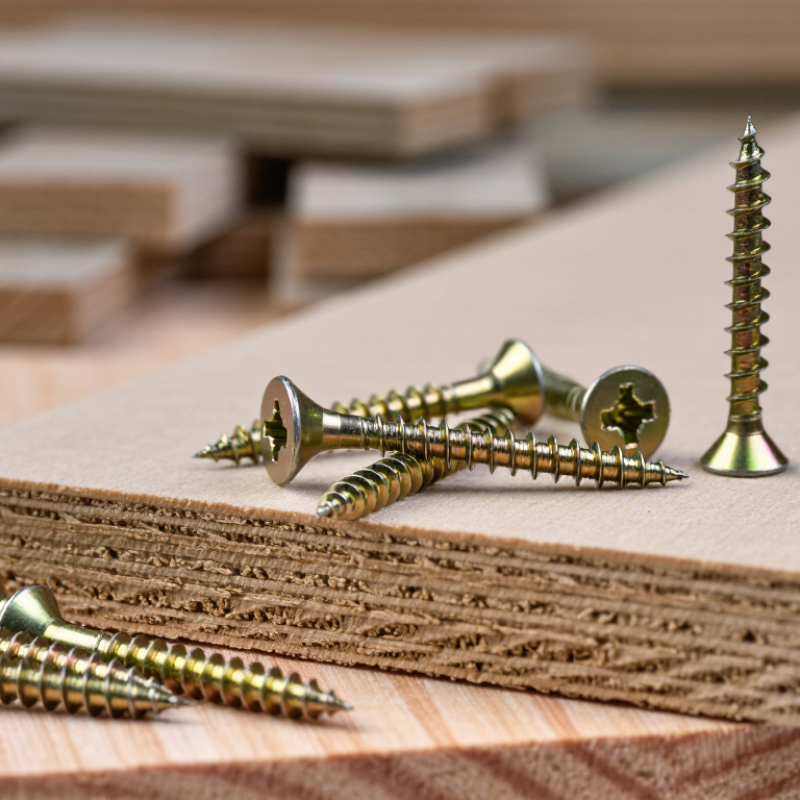
A chipboard screw is a wood screw designed to grip particleboard and other engineered panels. Its deep, widely spaced thread helps bite into the board’s compressed wood particles, while a relatively sharp point can reduce splitting during installation. Many versions also have a countersunk head, which sits flush when driven carefully. The exact shape varies, so “chipboard screw” describes a screw type, not one fixed specification.

The USDA Forest Products Laboratory’s Wood Handbook (FPL-GTR-282) lists a specific gravity of about 0.65 for its reference particleboard; actual panels vary by density and construction. That matters because screw holding depends partly on the material’s density and how far the threads penetrate. In practice, a screw that is too short may loosen under repeated loading, while overtightening can crush the panel surface and weaken the joint. A pilot hole can help near edges or in dense board, though it is not always needed. Not foolproof. For furniture assembly, cabinetry, or shelving, match screw length and diameter to the panel thickness, and test on an offcut when the board’s composition is unknown.

What Is a Chipboard Screw and What Is It Used For?

Chipboard screws are designed for particleboard and other engineered wood, with coarse threads that grip the material. The chart shows representative diameter-and-length combinations; available sizes vary, and the right screw depends on the material thickness and application.

How Its Thread and Head Are Designed

A chipboard screw is built to grip particleboard, MDF, and similar engineered panels. Its coarse, deep thread gives the screw more purchase in material made from compressed wood particles. The pointed tip helps it start cleanly, while the slimmer shank reduces the risk of splitting near an edge. The USDA Forest Products Laboratory’s Wood Handbook (FPL-GTR-282, 2021) identifies wood density, screw diameter, and thread penetration as factors affecting withdrawal resistance. In practice, a longer screw is not automatically stronger if it breaks through the panel.

The head matters, too. A countersunk head sits flush when driven into a matching countersink, useful for a smooth tabletop or cabinet side. Some designs add ribs beneath the head to help cut a recess, but these can mark a delicate surface. A pan or round head stays proud and can clamp a fitting without countersinking. Small detail, real difference. EN 320:2011 specifies a test method for measuring a panel’s resistance to axial screw withdrawal; it does not give one universal holding value for every board. Panel thickness, density, and edge distance change the result. A pilot hole may help near an edge, though the correct size depends on the screw and board. I would not trust appearance alone: a neat, flush head can still hide weak grip in a crumbly panel.

Common Materials, Coatings, and Sizes

Chipboard screws are commonly made from hardened steel, which helps them bite into particleboard and MDF. Their deep, coarse threads grip these materials, while a sharp point often reduces splitting. Some versions have zinc or other protective coatings to slow rust in dry indoor settings. Stainless steel may suit damp areas, but check the board and screw specifications rather than assuming every option is suitable.

Sizes are usually listed by diameter and length, such as 4 × 50 mm. Choose a length that passes through the first panel and anchors securely without emerging from the far side. For thin board, a shorter screw may be safer; for thicker panels, a longer one can provide more grip. The right choice still depends on panel density, edge distance, and the load. I have seen “more threads” treated as a complete solution, but poor placement can still weaken a panel.

Tips: Test one screw on an offcut. Near an edge, drill a small pilot hole and drive slowly. Stop when the head sits flush; overtightening can crush the board and loosen the hold.

Where Chipboard Screws Are Used

Chipboard screws are commonly used in flat-pack furniture, kitchen cabinets, shelving, and interior joinery because their coarse threads grip compressed wood particles. A screw driven into a cabinet side can secure a hinge plate; a shorter one can fasten a drawer runner without breaking through the panel. They are also useful for fixing chipboard flooring to joists, provided the panel and fixing pattern suit the load. Grand View Research estimated the global particleboard market at USD 22.6 billion in 2023, reflecting the material’s wide use in furniture and construction. That figure describes the panel market, not screw performance.

The USDA Forest Products Laboratory’s Wood Handbook explains that wood-based panel properties vary with material and manufacture, so one screw choice will not suit every board. In practice, coarse-thread screws are often selected for particleboard, with length matched to panel thickness and the joint. Near an edge, drilling a pilot hole can reduce splitting; overtightening can crush the surface and weaken the hold. For a heavy shelf, test the connection and consider a supporting rail rather than trusting one screw. Small details matter. I have seen tidy-looking joints loosen when installers drove screws too close to an edge or reused worn holes. The board’s grade, thickness, and expected load should guide the final choice.

How to Choose and Install the Right Screw

Choosing the right chipboard screw starts with the panel, not the toolbox. EN 312:2010 classifies particleboard into seven types, P1–P7, for different uses and moisture conditions. Check the panel marking and manufacturer’s fixing guidance before choosing a screw. For most indoor work, use a screw designed for particleboard, with coarse threads and a sharp point. Match its length to the material thickness; too much length can break through the far face.

The USDA Forest Products Laboratory’s Wood Handbook (2021), Chapter 8, explains that screw withdrawal resistance depends on factors including thread penetration, screw diameter, and the material’s density. In practice, leave adequate space from panel edges, and use a pilot hole near edges or in thin boards to reduce splitting and bulging. Drive the screw straight, stopping when the head sits flush. Over-tightening can crush the surface and weaken the hold. I still test on an offcut when the board is unfamiliar; it takes a minute, and sometimes the first choice is wrong.

Tips: Use a driver clutch on low torque. Keep the screw perpendicular. For cabinet hinges or repeated loading, test the fixing in the actual panel rather than relying on appearance alone.

FAQS

What is a chipboard screw?

It is a wood screw made to grip particleboard and similar engineered panels. Its deep, widely spaced threads bite into compressed wood particles.

What materials are chipboard screws commonly made from?

Many are made from hardened steel. Some have protective coatings for dry indoor use; stainless steel may suit damp areas, depending on the board and screw specifications.

How do I choose the right screw size?

Sizes often show diameter and length, such as 4 × 50 mm. Choose a screw that anchors securely without emerging through the far side.

Do I need to drill a pilot hole?

Not always. A small pilot hole can help near panel edges or in dense board. Test on an offcut when unsure.

Can a chipboard screw split a panel?

Its sharp point may reduce splitting, but it cannot prevent every split. Drive slowly, especially near an edge.

Should the screw head sit above or flush with the panel?

Many chipboard screws have countersunk heads designed to sit flush. Stop driving once the head reaches the surface.

What happens if I overtighten a chipboard screw?

Overtightening can crush the panel surface and weaken the joint. More torque is not always better.

Does a longer screw always hold better?

A longer screw may provide more grip in a thicker panel, but density, edge distance, and load also matter. I still find this easy to misjudge.

Conclusion

A Chipboard Screw is a fastener designed to join particleboard, MDF, and other wood-based materials. Its sharp point helps it start cleanly, while deep, widely spaced threads grip the material and help resist loosening. The head may be countersunk for a flush finish or shaped to sit above the surface, depending on the job. These screws are commonly made from steel and may have coatings that improve corrosion resistance or make them easier to drive. They come in a range of lengths and diameters to suit different material thicknesses and connection needs.

Chipboard screws are used in furniture assembly, cabinetry, shelving, and general woodworking. To choose the right one, consider the board thickness, the screw’s length and diameter, the expected load, and whether the finished project may be exposed to moisture. Align the parts carefully, drill a pilot hole when the material is prone to splitting, and drive the screw straight without overtightening. These steps help create a secure joint while protecting the board.

Charlotte

Charlotte

Charlotte is a seasoned marketing professional with a deep understanding of the company's portfolio and a passion for elevating its presence in the market. With a keen eye for detail and a commitment to excellence, she ensures that our professional blog is regularly updated with insightful articles......